
CNC sheet metal bending up to 4,000 mm
Our CNC press brake bends your parts up to 4,000 mm long and up to 15 mm thick, from sheets laser-cut in the same workshop. Our engineering office checks flat patterns and bend sequences before production.

- CNC
- Numerically controlled press brake
- 4,000 mm
- Maximum bend length
- 15 mm*
- Maximum bending thickness
* Maximum value: the bendable thickness depends on the bend length, the material and the required radii; it is checked for each part.
What we offer
- Bending of laser-cut partsin the same workshop
- Flat pattern calculationfrom your 3D model or drawing
- Multi-bend partsbend sequence worked out during preparation
- Bent parts ready for assemblywelding on site
Technical constraints to bear in mind
- Length and thickness: bend lengths up to 4,000 mm and thicknesses up to 15 mm. The bendable thickness decreases as the bend length increases.
- Radii and flanges: the inside radius and minimum flange length depend on the thickness and tooling; they are checked during the review.
- Holes near bends: a hole too close to a bend line can distort; our engineering office will flag it and suggest an adjustment.
- Material: the grade and rolling direction affect springback and bending behaviour.
- Tolerances: confirmed for each part at quotation stage.
Examples of parts we can make
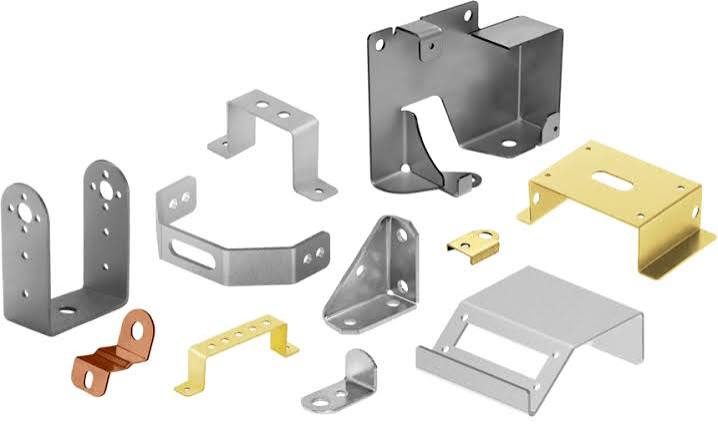
- Brackets, supports and consoles
- Covers, guards and cladding
- Custom angles and bent profiles
- Boxes, enclosures and cabinets
- Chassis and structural parts
Accepted files
For a bent part, a 3D model lets our engineering office calculate the flat pattern. A dimensioned drawing showing bend directions also works.
- STEP, IGS
- 3D model of the bent part: the ideal format, we calculate the flat pattern
- DXF, DWG
- Flat pattern with bend lines, or dimensioned 2D drawing
- Dimensioned drawing showing angles, radii and bend directions
- ZIP
- Several files or a complete folder in a single upload
Bending, a key step in sheet metal work
Bending turns a flat cut part into a formed part: a bracket, a box, a profile or a cover. On the press brake, the sheet is positioned against back gauges and then bent between a punch and a die. The quality of the result depends as much on preparation as on the machine: an accurate flat pattern, the right bend sequence and suitable tooling.
Preparation by our engineering office
From your 3D model or drawing, our engineering office calculates the flat pattern, that is the shape of the part before bending, taking the material and thickness into account. It checks access to each bend and the order in which to make them, so that the part does not collide with the machine.
Cutting and bending under one roof
Your parts are laser-cut and then bent without leaving the workshop. The flat pattern used for cutting is the one validated for bending, so both operations stay consistent and any drawing revision flows through the whole job.
Length, thickness and radius
Our CNC press brake bends up to 4,000 mm long, and up to 15 mm thick. The bendable thickness is not a single figure: it depends on the bend length, the material and the required inside radius. The longer the bend, the greater the force needed. That is why every part is checked before quoting, rather than judged against a maximum thickness alone.
From bending to assembly
Bent parts can be rolled or welded into complete sub-assemblies: cabinets, guards, chassis or brackets. For an initial quote, see our file preparation guide.
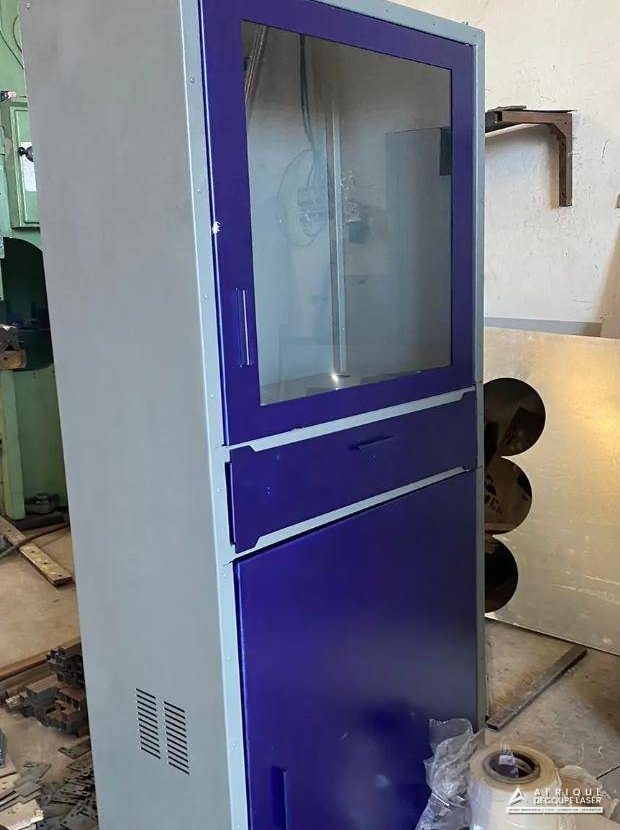
Folded sheet metal cabinet


What we need to quote
- 01The material and grade, if known
- 02The sheet thickness
- 03The bend length and number of bends per part
- 04The inside radius, if specified
- 05The quantity, and whether the need is one-off or recurring
- 06Your drawings or 3D models
Frequently asked questions
What length can you bend?
Bend lengths up to 4,000 mm and thicknesses up to 15 mm, on a CNC press brake. The bendable thickness depends on the bend length and the material.
What thickness can you bend?
It depends on the bend length, the material and the required radius: the longer the bend, the lower the bendable thickness. Our engineering office checks it for each part.
Do I need to supply the flat pattern?
No. A STEP or IGS 3D model of the bent part is enough: our engineering office calculates the flat pattern, taking the material and thickness into account.
What tolerances can you hold?
For sheet laser cutting, the tolerance is ± 0.2 mm (carbon steel, stainless steel, aluminium and copper). For tube cutting and bending, it is defined by the drawings. In every case, it is confirmed for each part at quotation stage, according to the material, the thickness and the geometry.
Related pages
Parts to bend? Send us your drawings.
Bending is preselected in the form. Give us the material, thickness, bend length and number of bends.